
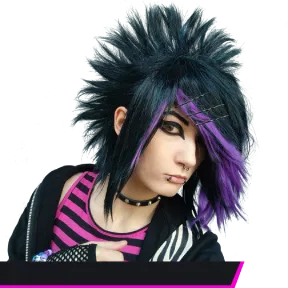

Cindy and I have a pretty serious dilemma: our favorite running gag about being hopelessly "unemployed" has just been officially thrown into the trash. For months, whenever comment sections under our videos got flooded with typical unsolicited advice like "go get a real job," "stop being an unemployed bum," or "unemployed behavior," we simply laughed it off. We embraced the meme, leaned into self-deprecation, and made it part of our identity. After all, what else can you say when you dress in neon colors, backcomb your hair into a storm cloud, wear heavy eyeliner, and wander through urban streets holding a camera? But that running gag is officially obsolete. A plot twist occurred that none of us saw coming: The Reverse Emo Changeling has formally entered the official court registry of periodicals and newspapers. The jokes about being jobless are over. Under statutory law, we now stand before you as legitimate press, and the disheveled creator you told to grab a shovel is, strictly speaking, on the clock.
How does someone like me go from being an internet outcast to a "professional graphic designer who doesn't know basic anatomy" and then, within mere months, into a registered journalist and reporter? Before getting into the mechanics, picture this surreal moment inside the courtroom. A stern, dignified judge of the District Court in Krakow is sitting at his desk, surrounded by piles of criminal codes, legal precedents, and judicial filings. Suddenly, he has to review an official press registration application submitted by alternative scene creators. The judge has to carefully read the editorial statutes, analyze our mission, stamp the state seal, and formally log the title "The Reverse Emo Changeling" into the state registry. In doing so, the Polish judiciary became permanently infected with the emo subculture.
The backstory of the name itself remains hilarious. About a year and a half to two years ago, we were sitting around reminiscing about our teenage ambitions of building an online creative presence. Everyone knows how it works: brain-fried ambition, tons of concepts, but zero clear focus. Online, your name, handle, and visual aesthetic dictate everything - it is the first barrier to entry, the deciding factor between someone clicking on your video or scrolling past. We spent hours pitching ideas, and none of them clicked. Finally, when creative fatigue set in and our system of alters decided to have a few drinks, someone blurted out this ridiculous string of words. Why that combination? "Changeling" is a direct reference to the shapeshifters from My Little Pony. In the pony canon, changelings operate as a massive swarm of many physical bodies governed by a single hive mind. For us, the dynamic is reversed: we are "Reverse" because an entire swarm of different identities, alters, and consciousnesses (plurality / DID) resides inside a single physical body. Pair that with "Emo" to reflect our stylistic and subcultural heritage, and the puzzle was complete. Does it sound cringey? Absolutely. But nobody at that table anticipated that this intoxicated inside joke would eventually end up stamped into official court records, filed directly between corporate conglomerates.
Why bother jumping through bureaucratic hoops in the first place? Look at the streets: the general public genuinely despises self-important social media influencers, and with good reason. People are exhausted by clout chasers waving smartphones on selfie sticks, disrupting public spaces, and harassing bystanders solely to manufacture algorithmic hype. The natural reaction from security guards and managers is an immediate: "Get lost, we don't need kids with phones bothering customers." Now imagine the violent cognitive dissonance when, instead of retreating, you flash an official press pass. The guard suffers an instant system crash. Standing before them is no longer an unaccountable civilian seeking online views, but an accredited media representative conducting official journalistic business. A reporter wearing steel-toe platform boots, heavy black eyeliner, teased hair, and carrying a press credential decorated with checkerboard patterns and ponies. We have not fully tested this in the field yet, but watching an official's brain short-circuit over that contradiction will be worth every drop of bureaucratic sweat.
Operating as legitimate press unlocks spaces that remain permanently closed to casual internet creators. High-level press conferences, public institutions, trade conventions, cultural festivals, and open court hearings - you enter under an entirely different legal framework. Instead of begging for attention, you hold a statutory mandate to ask questions. In our administrative culture, official paperwork, court signatures, and editorial letterheads still carry the weight of an ancient spell. An official who would dismiss an inquiry from an ordinary citizen is legally compelled to respond when presented with a formal press request. Furthermore, we gain the impenetrable shield of journalistic privilege and confidential source protection. When reporting on vulnerable subcultures, mental health crises, or systemic neglect, sources frequently face severe social or professional backlash. As press, we possess the right and absolute legal duty to refuse disclosure of our sources' identities, shielding them even against law enforcement inquiries. Additionally, intellectual property theft becomes a different legal battlefield: anyone attempting to hijack our creative assets or impersonate us is no longer bullying a faceless online user; they are infringing upon an officially registered publishing outlet.
Naturally, this coin has a darker, cumbersome flip side. The Polish Press Act dates back to 1984. It is four decades old, written in the era of midnight printing presses, rotary typewriters, and state censorship, which makes its archaic mechanisms awkward in the internet era. The biggest operational trap is the legal duty of publishing formal corrections. On a personal vlog, when a toxic critic spews bad-faith accusations, you simply block their account, delete the comment, and move on with your day. As a press outlet, you lose that luxury. If you publish investigative or opinion pieces and an affected party submits a formal demand for factual correction, you are legally obligated to review and publish it within statutory deadlines and designated formatting. Refusing without legal grounds lands you in court. While handling bad-faith disputes can be tedious, it also serves as an open challenge: if critics want to provoke drama through formal administrative channels, go right ahead. Every formal dispute offers fresh, high-octane fuel for subsequent gonzo commentary.
Complete loss of online anonymity is another mandatory sacrifice. Maintaining a legal periodical requires a public masthead, verified publishing addresses, and public editorial identities accessible in court case files. Fortunately, the heavy administrative burden does not fall upon my shoulders. As lead journalist, my responsibility centers on producing content, while the exhausting duties of Editor-in-Chief and procedural compliance are handled by Mighn Taghor at Toxic Echo studio. That division of labor is a blessing, given that some mornings I struggle to remember how to spell my own legal name - handing me administrative documents would guarantee operational catastrophe.
EDITORIAL LEGAL COMMENTARY (SUBSTANTIVE SUPPLEMENT)
This commentary serves as a substantive, educational supplement prepared by the editorial team of The Reverse Emo Changeling to explain the statutory nuances of Polish press law highlighted in the video essay. It is explicitly noted that this text does not constitute legal advice, a formal legal opinion, or legal representation. In individual legal disputes, professional consultation with qualified legal counsel is advised.
1. Status of Digital Periodicals under the Press Act:
Pursuant to Article 7(2)(1) of the Act of 26 January 1984 - Press Law, the statutory definition of press extends beyond print to include "all existing and emerging mass media channels resulting from technological progress, including broadcasting stations, wire-broadcasting networks, and digital systems disseminating periodic publications through sound, image, or combined audiovisual media." According to consistent Supreme Court jurisprudence (including Supreme Court Decision of 26 July 2007, IV KK 174/07), periodic digital publications, including blogs and online magazines appearing under a consistent masthead more frequently than once a year, fall under the obligation of registration in the Register of Journals and Periodicals maintained by the Regional Court (Article 20(1)). Formal judicial entry vests the publication with full statutory press status while imposing specific editorial obligations.
2. Definition and Legal Standing of a Journalist:
Article 7(2)(5) of the Press Law designates a journalist as "a person involved in editing, authoring, or preparing press materials, maintaining an employment relationship with an editorial board, or performing such activities on behalf of and under authorization from an editorial board." Polish legislation requires no state-issued license, academic degree, or guild membership. Journalistic status derives strictly from authentic creative engagement on behalf of a registered editorial title. This status confers specific privileges, including access to open judicial hearings (Article 357 of the Code of Civil Procedure, Article 356 of the Code of Criminal Procedure) and the statutory right to request public information from state and municipal bodies under public access legislation and Article 11 of the Press Law.
3. Journalistic Confidentiality and Source Shield:
The cornerstone of investigative reporting rests on Articles 15 and 16 of the Press Law. A journalist bears an absolute statutory obligation to maintain confidentiality regarding any information facilitating the identification of sources who requested anonymity, as well as third-party interests protected by law. Judicial exemption from journalistic confidentiality is strictly limited to criminal proceedings under narrow prerequisites: it applies solely to investigations involving the most severe felonies (the exhaustive catalogue under Article 240(1) of the Penal Code, covering treason, terrorist attacks, and murder) and is permissible exclusively when critical facts cannot be established through alternative evidentiary sources.
4. The Institution of Press Corrections:
Article 31a of the Press Law obligates the editor-in-chief to publish factual, objective corrections of false or inaccurate information upon written application from an affected party. Crucially, statutory corrections apply strictly to verifiable factual assertions, not to subjective assessments, artistic commentary, satire, or editorial opinions. The application must comply with rigorous procedural requirements (a 21-day filing deadline from publication, written format, applicant signature, and length restrictions not exceeding twice the disputed passage). The editor-in-chief holds the right and duty to reject improper correction requests under statutory exceptions (Article 33), particularly when demands lack factual relevance, contain defamatory material, or exceed legal boundaries.
5. Heightened Editorial Liability:
Holding press status entails heightened standards of professional diligence and factual accuracy in collecting and processing journalistic materials (Article 12 of the Press Law). Any unlawful infringement upon personal rights incurs joint civil liability between the author, editor-in-chief, and publisher (Articles 37 and 38), distinguishing recognized publishing from anonymous social media posting.
In conclusion: we have stepped onto the field under an entirely different set of rules. We navigated the court system, secured our registry signature, and stamped our presence into state records. Nobody can dismiss us as an unverified parody. Where this road leads remains anyone's guess, but The Reverse Emo Changeling has entered a new chapter. From this point forward, you never know when a reporter in alt clothes will emerge from around the corner and approach you with a microphone. The question is: do you think we are serious enough to pull this off? Because I have some doubts about that myself... 🖤

Comments / Discussion
Join the conversation and share your thoughts directly in our Telegram discussion thread.