
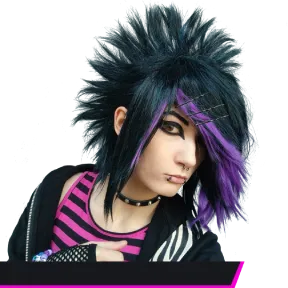

Earlier this October, a friend texted me all hyped up: "It's spooky season!". I didn't text back. I didn't want to be petty, rain on their parade, or play the resident buzzkill, but one intrusive thought immediately stuck in my head: why the hell a "season"? Since when do genuine passions, an affinity for darker aesthetics, creepy subcultures, and alternative style get measured on a corporate calendar like grocery store discounts? If you truly live this vibe, you don't lock it into a single sanctioned month. Then again, what can you really expect from a world where, years after parting with my scene bangs, I still catch myself doing that phantom head-toss to sweep away nonexistent hair, while the rest of society requires explicit permission from the calendar just to stop dressing like flat-pack catalog clones for a single night.
Halloween used to be an authentic, creative safe haven. Sure, for the mainstream it was still a seasonal blip, but it was that one rare window where unhinged creative energy was unleashed. People brainstormed outfits, went to war over DIY fits, hosted chaotic house parties, and ran nighttime photoshoots in old cemeteries. The weird kids - routinely bullied and ostracized all year long for their obscure hyperfixations - could finally slam the gas pedal to the floor without facing immediate social execution. It was a pure flex: who could craft the sickest makeup, sew a more grotesque costume from scratch, or embody a ghoul with genuine commitment. I still remember a school event years ago where I carefully mixed watercolor pigments and poured them straight into my eyes and under my lids so it looked like I was actively bleeding from my sockets. Don't panic, European Union safety standards for school supplies ensured I didn't blind myself, but the raw shock and sheer terror on people's faces was priceless. There was an unfiltered, DIY edge to it. Even looking back at historical roots, Polish culture carried its own ancient rituals for communing with the other side - look no further than Mickiewicz's Dziady [*].
And what does Halloween look like today? The entire space has been aggressively commodified and hollowed out of any soul. In place of passion, we have the latest haul off Temu or AliExpress: spending a couple of bucks on a cheap, factory-stinking polyester witch costume, draping the apartment in single-use plastic pumpkins, and firing up the feed just to chase numbers under #halloween. Zero effort, zero concept, zero risk. Everything has been dragged down to mindless consumption and overpriced makeup palettes pushed by influencers collecting affiliate kickbacks.
Which brings us to the most hypocritical phenomenon of all: playing the alt kid for a single night. This is not about slut-shaming anyone for showing skin - bodily autonomy belongs to everyone. The real question is: why is it only permissible on this one corporate-approved holiday? For 364 days of the year, these exact same normies look down on alternative people, sneering at scene and emo kids as walking cringe, freaks, and subhuman weirdos. But the moment October 31 rolls around, those very same folks suddenly slip into fishnets, smear on messy winged eyeliner, borrow studded belts, and start LARPing the shallowest stereotypes of "dark souls." What hits hardest is watching someone - an absolute, gray NPC in everyday life - look into the mirror with that alt makeup and, for a fleeting fraction of a second, genuinely feel cool. You can see they actually love how they look, that they are experiencing a rare spark of authentic self-expression. And yet, the very next morning, they snap right back into line, writing the whole thing off as a silly joke because their paralyzing terror of social judgment outweighs everything else.
Because modern adulthood is, by design, a systematic castration of passion. We are force-fed the lie that growing up requires ruthlessly purging yourself of individuality, personal style, and niche obsessions to become a compliant, interchangeable cog in the corporate machine. We watch people enter that meat grinder only to watch the light drain from their eyes, sliding into depressive numbness and trading their identity for sterile conformity. And instead of resisting, modern culture completely capitulates to the mold.
Look back at the dawn of the social internet and the MySpace era. Despite all its undeniable toxicity and relentless drama, MySpace stood as a monument to the fight for individuality. Kids spent endless hours hacking raw HTML and CSS just to ensure their profile was an unmistakable personal manifesto: from custom auto-playing profile tracks, to glitter gifs and subcultural motifs, down to the exact layout of their page. Your digital footprint declared exactly who you were and what you stood for. Then Facebook arrived, bleached the landscape in sterile corporate gray, and murdered customization culture in cold blood. Today's social media is a wide-open graveyard of creativity. Whenever I scroll through feeds, I keep the sound permanently muted just to stay sane: thousands of identical accounts parroting the exact same viral audio, mimicking the exact same canned micro-movements, churning out hollow trend templates without a single original thought. Everyone churns out algorithmic content purely to show their face and farm a tiny hit of dopamine from likes.
We are trapped inside platforms engineered like slot machines, fine-tuned to maximize chemical dependence. Worse still, we subsist on the illusion of community. In truth, we are interacting with ghosts: an enormous share of network traffic, hostile comments, and manufactured hype is generated by automated bot farms running virtual machines around the clock on behalf of corporate conglomerates and PR agencies. The dead internet theory stopped being a dystopian meme; it became standard market reality. A uniform herd of consumers, engineered to think and react in lockstep, is simply far easier to monetize.
And out of this sterile landscape emerges a grotesque paradox. People are subconsciously exhausted by the monoculture, sensing the void, and searching for an exit. That is the exact engine driving the contemporary scene revival - the longing for the 2000s, emo-core riffs, and alt aesthetics. Yet that very rebellion is immediately poisoned by a fresh paranoia: the suffocating dread of being branded a "poser." Young kids discovering subcultures aren't handed freedom; they are slapped with a new rulebook of institutional surveillance. Instead of building real community, they obsess over checking off boxes: are my bangs teased high enough, am I streaming only the elite bands cleared by online gatekeepers, will I get exposed and ostracized?
Personally, I am exhausted by the hollow discourse. In my daily life, finding people from the alt scene is nearly impossible, and stumbling across a truly compatible crew is like finding a needle in a haystack. Walking down the street in a simple skeleton hoodie around late October means enduring condescending sneers from pedestrians who assume I'm wearing a cheap costume, when in reality, it's just my everyday wardrobe. I watched clips from the recent "Halloween march" in Krakow - instead of a vibrant, rebellious carnival of weird kids, it looked like a somber parade of suppressed figures draped in safe black, terrified of doing anything beyond the absolute bare minimum lest someone snap a photo, post it online, and tear them to shreds.
That is the crux of the whole diagnosis: modern culture forces us into a suffocating, double-edged performance. Everyone is desperate to feel unique, everyone wants the badge of the "weird kid," because being ordinary is social death. But you are only permitted to be "weird" within the safe, sanitized boundaries of corporate approval - carefully ensuring you never make a normie uncomfortable or violate group consensus. If your individuality is real, if it shatters the mold and demands raw courage, you are instantly shoved back to the margins as an outcast. Genuine authenticity doesn't arrive in a poly-mailer from Temu, nor does it come from checking off an algorithmic trend on TikTok. It comes from the willingness to be pointed at, laughed at, and remaining unapologetically yourself in a world terrified of any scratch upon the smooth surface of conformity.
Footnotes
Editor's Note: Yeah, we get it - tales of tainted candy and needles in chocolate bars are 99% urban legend and moral panic. But the gap between edge-lord trolling and actual, reckless stupidity is closing fast. Dig into the comments on almost any platform, and you'll find people hyping this shit up or outright pushing to make it happen. We refuse to brush it off just because it used to be just folklore. Plain and simple: there are plenty of twisted minds out there, and keeping an eye on your kid's stash isn't paranoia - it's the bare minimum.
Comments / Discussion
Join the conversation and share your thoughts directly in our Telegram discussion thread.